
Budapest Stag Do Guide
Budapest has all the ingredients for a serious stag weekend, but the city works best when you know how to use it. The Danube splits two very different sides of the capital, the main nightlife districts are compact enough to move between without losing half the evening, and there is far more to do than simply follow the crowds into the nearest ruin bar.

This guide covers the practical side of planning a Budapest stag do: where to stay, what to book, how to structure the weekend, getting around, nightlife, costs and the local details that can make the difference between a well-run trip and three days of improvisation.
Planning a stag weekend in Budapest? Tell us your dates, group size and what sort of trip you have in mind.
Why Budapest Works So Well for a Stag Do
Budapest earned its reputation as a stag destination through cheap beer and nightlife, but that description is increasingly outdated. What still makes the city particularly good for groups is something more practical: a lot can happen within a relatively small part of the city.
Stay in the right area of Pest and you can walk from your accommodation to dinner, continue to bars and reach several major clubs without spending the night organising taxis. The Danube is only a short distance away, while many of the city’s more specialist daytime activities can be reached with pre-arranged transport.
That geography matters more than it sounds. A stag weekend with twelve or fifteen people moves very differently from a city break for two. Every unnecessary journey becomes slower, somebody disappears into a shop, somebody else is still getting ready, and a twenty-minute gap in the itinerary can easily become forty-five.
Budapest gives organisers room to shape the weekend around different personalities. One group might want shooting or tank driving during the day and a late night afterwards. Another may prefer a long lunch, a private Danube cruise and several bars, without booking an organised activity every few hours. Mixed-age groups can keep things relatively civilised; those arriving with wilder intentions have options too.

The contrast between the different parts of Budapest also helps. The historic riverfront and monumental architecture give the trip a genuine sense of place, while the streets around the central nightlife districts become a completely different environment after dark.
You can spend the afternoon beside the Danube and finish the night several streets deep into District VII without the weekend feeling like one continuous purpose-built party resort. Groups still deciding whether that balance suits them can compare the best stag do destinations in Europe by nightlife, activities, budget and season.
Organising the trip with people who work locally has another advantage. At STAG VIP Budapest, we arrange weekends on the ground in the city, not from a catalogue of European destinations. That experience helps us judge which activities genuinely fit together, how much travel time to allow and which parts of Budapest suit a particular group.
The result is why Budapest remains so well suited to a stag do: you don’t need to do everything the city offers. You need to put the right things together in the right order.
American groups may call the same celebration a bachelor party rather than a stag do. Our guide to the difference between a stag do and bachelor party explains how the terminology changes between regions.
When Is the Best Time of Year for a Budapest Stag Do?
Budapest works as a stag destination throughout the year, but the experience changes with the season. The best time depends on whether your group wants outdoor activities and evenings beside the Danube, a nightlife-led weekend or a quieter period with more flexibility.
Spring: Strong All-Round Conditions
Spring is one of the most practical times for a Budapest stag do. From April onwards, longer days and milder weather make it easier to combine daytime activities, walking between central locations and evening drinks on terraces.
It is also a busy period for stag groups, especially from late April through June. Central accommodation, private cruises, vehicles and the strongest activity times can fill earlier than expected, so the main bookings should be secured once the group has confirmed the dates.
March can still be cool and changeable, making a flexible mix of indoor and outdoor plans the safer option.
Summer: Long Evenings and Maximum Choice
Summer suits groups that want to make full use of the Danube, outdoor venues and Budapest’s late-evening atmosphere. Longer daylight hours give the schedule more breathing room, while river cruises and terraces can become a natural bridge between the daytime programme and nightlife.
The trade-off is demand. Budapest attracts many visitors during summer, and popular weekends place more pressure on central accommodation and prime booking times. Hot afternoons can also make an overloaded itinerary feel harder than it looked during planning.
For summer trips, allow a proper break before dinner and avoid placing every major activity in the hottest part of the day.
Autumn: One of the Best Compromises
September is an excellent choice for groups that want a strong combination of outdoor possibilities, nightlife and manageable daytime conditions. The city remains lively, while cruises, walking and open-air plans can still fit comfortably into the weekend.
As autumn progresses, evenings become cooler and the weather less predictable. October trips work best with indoor alternatives available, although Budapest’s bars, clubs, restaurants and organised activities continue regardless of the season.
Winter: Better for Nightlife-Led Weekends
A winter stag do needs a different rhythm. Cold weather and shorter days make long outdoor schedules less appealing, but indoor activities, thermal baths, restaurants, ruin bars and clubs can still produce a full weekend.
Winter is best for groups that are happy to build the trip around food, nightlife and one or two structured bookings. Keep outdoor travel time under control and choose accommodation that allows the group to reach the central evening areas without complicated journeys.
For the widest mix of daytime and evening options, late spring, early summer and September are the strongest all-round periods. However, Budapest does not have one compulsory stag season. A well-planned winter weekend can work just as well when the programme suits the conditions.
What Does a Budapest Stag Weekend Look Like?
Flights and accommodation may define the dates, but the pace of the trip usually determines whether everything else runs smoothly. Trying to squeeze something into every available hour sounds ambitious on a spreadsheet and feels very different after twelve people have stayed out until 4am.
A sensible schedule leaves enough structure to keep everyone moving without turning the groom’s trip into a military operation. The strongest itineraries tend to have one or two fixed anchors each day, with breathing room around them for food, drinks and the inevitable change of plans.

Arrival Day: Keep the First Evening Flexible
For most groups, the first challenge is simply getting everybody from the airport to the accommodation without losing momentum.
Once bags are dropped off, resist the temptation to schedule three separate bookings before midnight. Delayed flights, airport queues and late arrivals can quickly destroy a tightly packed first evening.
A simple start usually works best: check in, grab food, have the first few drinks and explore the central districts.
If you want a pre-arranged surprise, an airport transfer, limousine or party vehicle can make the journey itself part of the celebration. Our Budapest stag transport guide compares the main ways to move a group around the city and explains how each option fits into the weekend.
The important thing is leaving enough flexibility for everyone to settle in. There is plenty of time for the serious programme tomorrow.
The Main Day: Put the Big Booking in the Middle
Saturday is usually when the headline event belongs.
Shooting, karting, tank driving, competitive games and other organised sessions generally work better from late morning through the afternoon than immediately after breakfast. If shooting is likely to be the main event, our Budapest gun shooting guide explains the different formats and what to consider when planning it for a stag group.
Location can change the shape of the day. Two attractions that look close on Google Maps may involve very different transfer times for a larger party. Experiences outside central Budapest, such as tank driving can consume more of the schedule than the activity duration suggests, so include the transfers before making the final choice.
Afterwards, leave a genuine break before dinner. Returning to the accommodation for showers, fresh clothes and an hour without a schedule is not wasted time. It is often what keeps the evening alive.
The Final Morning: Don’t Overbook It
Sunday morning has defeated many optimistic itineraries.
A leisurely breakfast or lunch, a thermal bath visit, a walk along the river or simply a later checkout can be far more realistic than another fixed booking at 9:30am.
Departure logistics also deserve more attention than they usually receive. Ten people leaving on the same flight are easy enough to coordinate; fifteen people heading to three different airports or departure times are not.
The final hours should therefore have less structure, not more. Leave enough margin for luggage, food, missing phone chargers and the one person who somehow still hasn’t packed.
A good stag trip should finish with everyone talking about what happened — not sprinting through the terminal because somebody decided Sunday morning needed one last adventure.
Choosing Stag Activities in Budapest
The hardest part is rarely finding something to do. It is deciding what deserves several hours of a short trip.
Location and duration determine how an activity fits into the weekend. A session in central Pest can sit comfortably between lunch and dinner, while an experience outside the city may occupy much of Saturday once transfers are included. If time on the river is part of the plan, our Budapest Danube cruise guide compares the available formats and explains where they fit best.
For a first visit, one major daytime booking is usually enough to give the day a centrepiece without forcing everyone to race between reservations. If you want two, check how they connect before committing to both.
Our stag do activities in Budapest guide compares the main options, including shooting, driving, cruises, competitive sessions and more unusual choices.

Building a Stag Weekend Around Your Group
There is no single Budapest formula that works for every set of friends. A trip for six former university mates in their thirties needs a different rhythm from twenty lads arriving with a very different idea of how Saturday should end.
Before filling the schedule, think about the people coming. Temperament is more important than age. Some groups want competition and fixed plans; others would happily spend three hours over lunch before deciding what happens next. The groom should shape the final choice, especially when surprises, stag pranks in Budapest or anything involving public attention are being considered.

Group size changes the practical side as well. Once numbers climb into the mid-teens, restaurant reservations, transport and simply getting everyone to the next booking take more time. Larger parties usually benefit from fewer fixed commitments and more realistic margins between them.
If you are still deciding what kind of trip suits the groom and the people travelling with him, our Budapest stag do ideas guide explores the different directions the weekend can take.
Where to Stay in Budapest for a Stag Do
For a stag trip, the cheapest apartment is not always the cheapest decision.
Saving a few euros per person by staying far from central Pest can mean repeated taxi journeys, longer waits and the daily challenge of moving everyone across town. For most groups, location is worth paying a little more for.
The sweet spot is usually on the Pest side, within easy reach of Districts V, VI and VII. From there, restaurants, bars, clubs, the Danube and many central meeting points are close enough that transport doesn’t dominate the schedule.
Property rules are as important as the postcode. Before booking your stag accommodation in Budapest, check whether the property accepts larger male groups and what it permits regarding noise and visitors. An apartment that looks ideal on a booking platform may be a poor choice if it has strict quiet hours and residents on every side.

District V: Central and More Polished
District V runs along the Pest side of the Danube, close to the riverfront, central restaurants and many of Budapest’s landmark sights.
It suits groups that want a central base without sleeping directly in the busiest party streets. Restaurants, riverside walks and major sights are nearby, while the nightlife of Districts VI and VII remains easy to reach.
The trade-off is price. Accommodation here can cost more than comparable options farther out, particularly around the most desirable central streets.
For a shorter stay, that premium can be worthwhile when convenience is the priority.
District VI: A Strong All-Round Base
District VI places you between the inner centre and much of the late-night action.
Areas around Andrássy Avenue, Oktogon and the streets leading towards the Jewish Quarter give you excellent access to restaurants, bars and public transport. This works especially well when the itinerary spans several parts of central Pest instead of keeping every evening in one neighbourhood.
One local rule is especially relevant to stag groups: do not assume that drinking in the street is acceptable simply because other visitors are doing it.
Keep open drinks inside bars, licensed terraces or accommodation where the property rules permit them. The rules section below explains the District VI restriction in more detail.
District VII: Closest to the Late-Night Action
District VII is the obvious choice for groups that prioritise bars over peace and quiet.
The inner part of the district contains the Jewish Quarter and many of the streets associated with Budapest’s ruin bars, casual drinking spots and late-night venues. For a crew expecting to return home in the early hours, being able to walk back can be a major advantage.
But proximity cuts both ways.
Apartments here can sit inside residential buildings where permanent residents are understandably less enthusiastic about somebody else’s stag weekend. Noise in communal areas, shouting from balconies and continuing the party after returning home are exactly the behaviours most likely to create problems.
Choose the accommodation for its actual rules and suitability, not simply because the map shows several bars around the corner.
Areas That Make Less Sense for Most Stag Groups
Budapest is much larger than the compact centre visitors spend most of their time in.
There are perfectly pleasant neighbourhoods farther into Buda and the outer districts, but a stag group usually gains little from staying there unless there is a specific reason. What looks like a short distance on a city map can turn into multiple transfers once a dozen people are involved.
Buda itself should not be dismissed—it is worth crossing the river for the scenery, baths, restaurants and sightseeing—but central Pest remains the more practical base for most stag weekends.
The exception is a group deliberately looking for a quieter trip or accommodation with particular facilities that cannot be found centrally.
Wherever you stay, think about the journey you will make at 2am, not just the attractive apartment photographs you see while booking it.
Budapest Nightlife for Stag Groups
Budapest after dark is much bigger than the ruin-bar circuit, although that is where many first-time visitors naturally begin. Within central Pest you can move between scruffy courtyards, cocktail bars, pubs and full-scale clubs without committing the entire evening to one venue.
That choice helps on a stag night. Twelve people rarely agree on the same music, drinking pace or definition of a good pub, so several alternatives within walking distance allow the group to change direction without losing the evening.
For a broader view of the city after dark, our Budapest nightlife guide for stag groups explains how the main districts, ruin bars, pubs, clubs and late-night options fit together.
For choosing where to start the evening, see our guide to stag-friendly bars in Budapest, including options for larger groups and rooftop drinks.
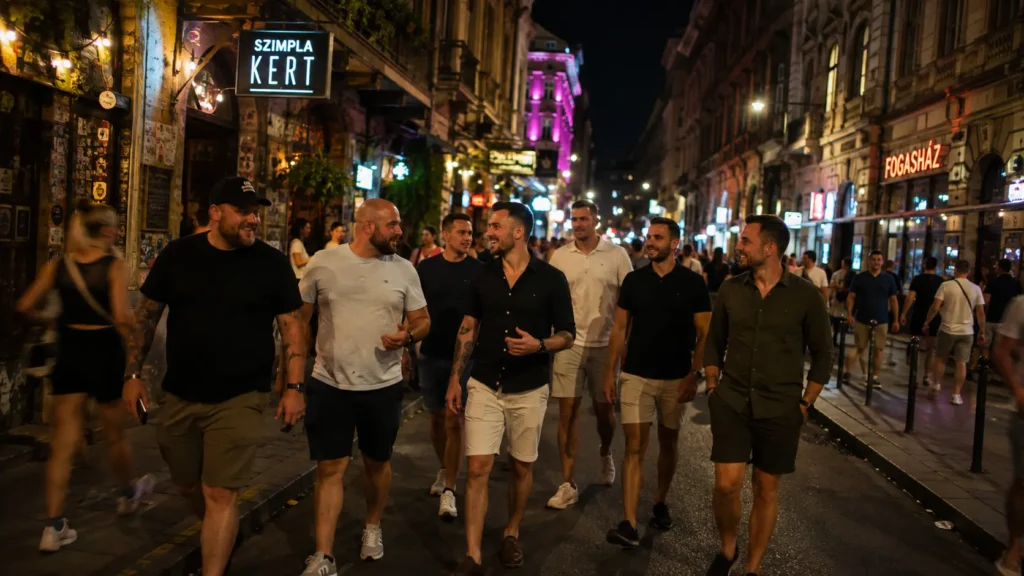
The mistake is assuming that everything worth visiting sits on one famous pub-crawl route.
Ruin Bars: Worth Seeing, but Know What to Expect
Ruin bars remain part of Budapest’s identity, but the most famous names are no longer underground secrets.
Szimpla Kert, on Kazinczy Street, is the obvious example. Its mismatched rooms, courtyards, installations and deliberately chaotic interior still make it worth seeing at least once, particularly for newcomers. It is internationally known and heavily visited, so treat it as a landmark nightlife venue, not a hidden local drinking den.
For a stag party, Szimpla can be an excellent early stop without becoming the only destination.
Explore the ruin-bar district as a neighbourhood, not a single-address destination.
Clubs: Decide What Kind of Night You Want
Budapest’s larger clubs differ in layout, music and crowd.
Instant-Fogas Complex remains one of the biggest names in District VII, with multiple dance floors and music styles inside one interconnected venue. Its scale helps when tastes differ: splitting up for an hour does not necessarily mean splitting the group across Budapest.
More polished central clubs attract a different crowd and can suit groups looking for a proper late-night finish on the dance floor.
Selective clubs apply stricter dress and behaviour standards. Arriving heavily intoxicated, in novelty costumes or after treating the pavement as a pre-club bar is a poor strategy.
No reservation can make a doorman ignore behaviour.
If the night is going to finish on the dance floor, our guide to Budapest’s best clubs compares the main options by music and style.
Don’t Spend the Whole Night Moving
Six bars and two clubs can look impressive in an itinerary. In practice, every move with a large party costs time.
Bills need settling, toilets suddenly become urgent, jackets disappear and somebody invariably orders another round just as everyone else is leaving.
Two or three well-chosen stops can produce a much better night than constantly chasing the next address.
A hosted pub crawl works well when nobody knows Budapest and you want the route managed for you. Returning visitors may prefer to choose an area and let the evening develop without a fixed sequence.
Getting Home After a Night Out
Budapest’s overnight public transport network now offers broader coverage and more direct connections across the capital. Plan current night routes through BudapestGO, as screenshots and older travel articles may no longer reflect the service.
Walking is often simplest when your accommodation is in central Pest. Taxis work well for longer late-night journeys, but if the group needs several cars, make sure everyone has the destination before the first one leaves.
At 3am, “we’ll meet you there” is not a transport strategy.
Have a direction for the night and secure anything that genuinely requires advance booking. Beyond that, some freedom usually works better than trying to script every stop from the first beer to the final club.
Dinner Before a Stag Night in Budapest
Dinner is one of the easiest parts of a stag do to underestimate.
After an afternoon programme and a few drinks, sitting twelve or fifteen people down for a proper meal can reset the entire evening. Skip it, and the first rounds after dark tend to have a much stronger effect than anyone intended.
For a larger party, focus on three things: seating, location and timing.

Book for the Size of the Party
Budapest has no shortage of restaurants, but finding a table spontaneously is very different when there are fourteen of you.
Reserve in advance and make sure the restaurant knows the real number attending. Several small tables scattered around the dining room defeat much of the point; ideally, everyone should be seated together or in one clearly defined section.
Location deserves equal attention. A fantastic restaurant on the wrong side of town can add an unnecessary journey between the afternoon and the night ahead. Central Pest generally makes that transition much easier.
Hungarian Food, Steak or Something Simple?
A stag dinner does not need to become a gastronomic expedition.
Traditional Hungarian cooking is worth considering if the group wants some local character on the trip. Goulash, paprikash, grilled meats and other substantial dishes also have the practical advantage of putting a proper meal behind everyone before a long night.
Steakhouses work well when dinner itself is intended to be one of the evening’s anchors.
Sometimes burgers, pizza or familiar comfort food are exactly right. After an afternoon of competition, drinks or travel, a lengthy formal meal can drain the momentum before the night begins.
Match the restaurant to the people at the table, not to what looks most impressive in an itinerary.
Choose the Right Dinner Time
Allow enough time beforehand for everyone to return to the accommodation, shower and change. This is particularly important after paintball, driving, outdoor sessions or anything else where going directly to a restaurant would be optimistic.
Dinner works best as the bridge between the daytime programme and the night ahead.
Allow enough time beforehand for everyone to return to the accommodation, shower and change. This matters particularly after paintball, driving, outdoor sessions or anything else where going directly to a restaurant would be optimistic.
Then give the booking some margin at the other end. A slow bill, an extra round or the inevitable person disappearing to find an ATM should not make the next part of the night late before it has even started.
Entertainment at Dinner: Know Your Audience
For some stag parties, dinner is also the obvious moment for the groom’s surprise.
A private room or suitable venue makes entertainment easier to manage than improvising later in a crowded bar. It also keeps the prank or show inside a setting where it has been arranged and approved.
Groups comparing private shows, adult dinners, wrestling and other performer-led options can use our guide to sexy stag do activities in Budapest before choosing the right format.
But this comes back to knowing the groom.
If he will find the whole thing hilarious, build it into the evening. If he has spent six months explicitly saying he does not want to be stripped, handcuffed or publicly humiliated, perhaps believe him.
Dinner brings everybody back together before the night accelerates. Good food helps. Good timing helps even more.
Getting Around Budapest with a Stag Group
Budapest is relatively easy to navigate, but moving twelve people is never quite the same as moving two.
Central Pest rewards walking. Many restaurants, bars, clubs and riverside meeting points sit close enough together that arranging transport for every journey creates more hassle than it solves. Once the itinerary stretches beyond the centre, however, a little coordination becomes valuable very quickly.
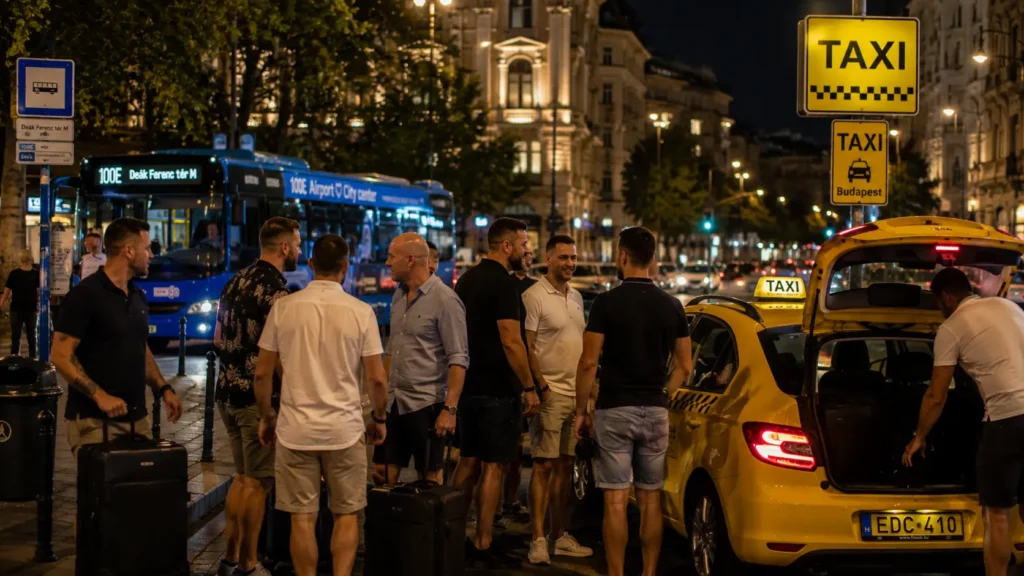
From Budapest Airport to the Centre
Budapest Ferenc Liszt International Airport sits outside the inner districts, so the arrival transfer is the first logistical decision of the trip.
The 100E Airport Express runs around the clock between Budapest Airport and Deák Ferenc tér via Kálvin tér. A dedicated airport shuttle ticket is required; the fare is 2,500 HUF as of August 2026.
For a few friends travelling light, this is an easy option.
Larger stag parties may find private transport simpler. Everyone leaves together, the luggage stays together and nobody starts the weekend trying to locate the half of the group that disappeared into a different vehicle.
The transfer can also become part of the arrival. For groups that want to start celebrating immediately, a limousine or party vehicle turns the airport journey into part of the experience.
Walking and Public Transport
Once you are based centrally, your feet will handle more of Budapest than you might expect.
Metro, tram and bus services help when crossing between neighbourhoods or travelling beyond the inner streets. Contactless Pay&GO ticket purchase and validation is available across the metro network, allowing passengers to buy the appropriate single journey with a bank card or compatible device at the validator.
Use BudapestGO for service changes, night connections and real-time information. It is more reliable than memorising routes or saving a static transport map before departure.
One warning for larger parties: give everyone the destination before leaving. Twelve people cannot change lines or jump onto a departing tram with quite the same ease as two.
When Private Transport Makes Sense
Some stag activities take place well beyond central Pest.
Outdoor shooting grounds, tank driving, paintball, quad programmes and other specialist venues can require travel beyond the areas visitors normally explore on foot. In those cases, arranging the outward and return journeys together is often part of making the booking practical.
Private transport also earns its place when fixed reservations need to connect cleanly. If an afternoon session finishes outside the centre and dinner begins ninety minutes later, leaving fifteen people to improvise their own return introduces a problem you do not need.
Skip private transport when everything is happening within a few central streets.
There is no prize for spending the entire weekend inside a minibus.
Taxis: Keep Everyone on the Same Page
Taxis work well for shorter journeys, late returns or smaller parties splitting away from the main programme.
Budapest’s licensed taxis use regulated fares, with the official price the same at all times of day and for every operator. Since 1 August 2026, journeys to or from Budapest Airport have a separate 2,100 HUF airport base fare. For a stag group, coordination is usually the bigger issue: if several cars are needed, send the exact destination to everyone before the first vehicle leaves.
For app-based booking, Bolt operates licensed taxis in Budapest, while established local taxi companies also have their own booking options.
Avoid accepting rides from random drivers soliciting passengers around nightlife areas. Use a licensed taxi ordered through an established operator or app.
Walk when Budapest makes walking easy, use public transport when it saves time, and arrange vehicles when keeping everyone together is the priority.
Budapest Stag Do Rules You Should Know
Budapest is used to stag parties, but being on a stag do does not create a separate set of rules.
Most visitors never encounter a serious problem. Trouble usually starts when behaviour that would be unacceptable at home suddenly seems reasonable because everyone is abroad: drinking in the street, shouting beneath residential windows, damaging accommodation or arguing with security after being refused entry.
A little awareness goes a long way.
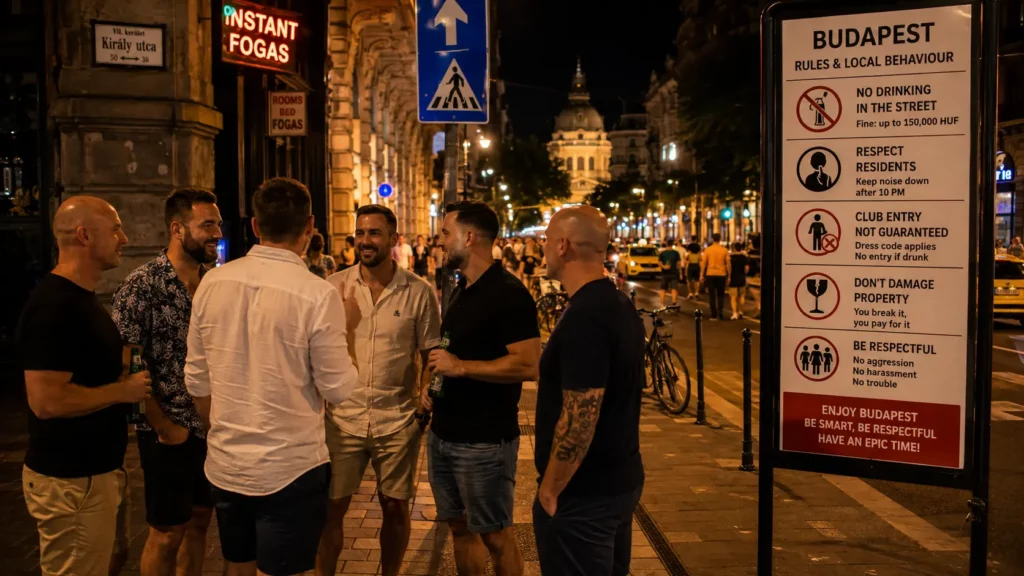
Don’t Treat the Street Like a Bar
Public drinking is not something to assume is permitted throughout Budapest.
Rules vary by district and by the status of the public space. In District VI, alcohol consumption is prohibited on public spaces owned by the local municipality, except in authorised areas such as licensed terraces and permitted events.
The practical rule for visitors is simple: drink in bars, restaurants, licensed terraces or wherever your accommodation explicitly allows it.
Walking between venues with open bottles is rarely worth the potential hassle.
Residential Buildings Are Still Residential
Many central Budapest apartments are inside buildings where permanent residents live next door, above and below.
That becomes easy to forget when ten friends have rented a large flat for the weekend.
Keep communal hallways, courtyards and balconies under control, particularly late at night. Returning from a club does not mean the afterparty automatically belongs in the apartment. Noise complaints can escalate quickly, and accommodation providers may enforce stricter conditions than the surrounding nightlife suggests.
Read the house rules before booking; discovering the restrictions after a complaint is too late.
Club Entry Is Never Guaranteed
A reservation, guest-list arrangement or planned club visit does not guarantee entry regardless of how the group arrives.
Door staff can refuse entry because of intoxication, aggressive behaviour, inappropriate clothing or conduct toward staff and other guests. Large male parties naturally attract more attention at the entrance than two people walking in quietly.
Fancy dress can also work against you at more selective venues. Save the most ridiculous groom outfit for somewhere that will appreciate it, or risk discovering at midnight that nobody wants to admit the man dressed as a giant banana.
If a doorman says no, arguing almost never turns it into yes.
Keep Pranks Under Control
Embarrassing the groom is part of the tradition for plenty of stag parties. Involving strangers, public services or unsuspecting members of the public is where the joke can stop being funny.
Any organised prank should take place in an appropriate setting where the people involved know what is being staged. Fake-police or arrest-style entertainment, for example, should not be improvised in public streets or on transport.
The groom can be surprised. Budapest doesn’t need to be.
Respect the Danube
A night beside the river looks spectacular, but the embankments and bridges are not places for drunken dares.
Don’t climb barriers, jump into the Danube or encourage somebody else to do it for a video. The river is a working waterway with strong currents and boat traffic, not an extension of the bar district.
The same common sense applies on private cruises: follow the crew’s instructions and keep everyone safely onboard.
Know When the Joke Has Finished
The easiest groups to host are not necessarily the quietest. They understand the difference between a wild night and behaviour that damages property, targets strangers or ignores venue staff.
For a deeper look at the mistakes that can derail the trip, read our Budapest stag do red flags guide before you travel.
A successful stag weekend does not need to be sensible; it only needs enough judgement to recognise the line.
How Much Does a Stag Do in Budapest Cost?
Budapest can still offer good value compared with many Western European capitals, but its old reputation as an exceptionally cheap party destination is no longer a reliable basis for planning.
Your total depends on travel style, accommodation and bookings—not simply the price of a pint.
A crew sharing apartments, eating casually and choosing one major event will spend very differently from a smaller party using private transfers, premium restaurants, several organised sessions and table service at night.
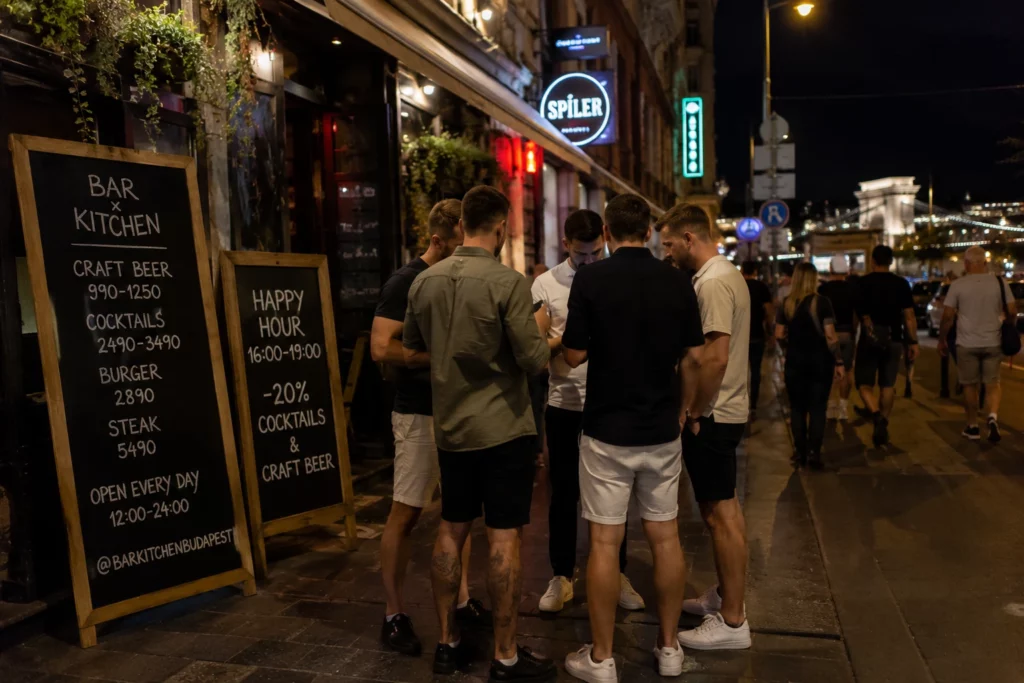
What Should You Budget Per Person?
There is no single price that applies to every Budapest stag weekend. Group size, season, accommodation, the number of private bookings and the type of nightlife can change the final figure substantially.
For a group of approximately 12–15 people staying for two or three nights, the following August 2026 figures provide a realistic starting point. Flights are not included.
Central mid-range accommodation: approximately €40–€60 per person per night, or around €80–€180 for a two or three-night stay.
Organised nightlife: a hosted ruin-bar crawl commonly starts at around €20–€30 per person, depending on the inclusions.
Daytime activities: allow approximately €35–€100 or more per person for one organised activity. Specialist driving programmes, larger shooting packages and activities requiring private transfers can sit above this range.
Private group experiences: boats, limousines, party vehicles, performers and private entertainment are often priced partly or entirely for the group. The per-person cost therefore falls as more people share the fixed price.
Food, drinks and club spending: keep these separate from the organised programme. A casual weekend and one involving steak dinners, cocktails or premium club tables belong to very different budgets.
Smaller groups of four to eight people should expect some private experiences to cost more per person because the same boat, vehicle, venue or performer fee is being divided between fewer guests.
Use these figures as planning ranges, not as a guaranteed package price. Confirmed dates, final group size and the chosen activities are needed before an accurate total can be calculated.
Accommodation
This is usually one of the biggest variables.
Prices vary with season, location, property type and how early you reserve.
A cheaper property far outside central Pest may simply move part of the saving into taxis and lost time.
For a short stay, paying more for the right location can be money well spent.
Food and Drinks
Budapest covers almost every level of spending, from quick street food and neighbourhood pubs to steakhouses, cocktail bars and high-end restaurants.
The deciding factor is where and how you intend to eat and drink.
A few rounds in a casual pub bear little resemblance to cocktails in a rooftop bar or bottle service in a club. The same applies to food: burgers between bookings and a long steak dinner belong to completely different budgets.
Leave room for spontaneous spending; there is no need to calculate every drink before the flight.
Daytime Bookings
Group size can change the per-person figure dramatically.
Some services are priced largely per participant. Others involve vehicles, instructors, private venues, boats or performers with significant fixed costs. Splitting those expenses between fifteen people can produce a very different figure from splitting them between six.
More elaborate does not automatically mean better value. One standout booking that everybody wants can be a stronger use of the budget than three cheaper fillers added simply because the schedule has space.
Transport
If you stay centrally and structure the itinerary intelligently, everyday transport should not dominate the budget.
Walking and public transport cover plenty of journeys. Costs rise when the programme includes locations outside the centre, multiple private transfers or vehicles kept available for the party.
Airport transport varies by approach: public transport keeps costs down, while a private minibus, limousine or party vehicle charges more for convenience and, in some cases, entertainment.
Nightlife
This is the category most likely to escape the spreadsheet.
Entry fees, rounds, cocktails, late-night food, taxis and club spending accumulate quickly, particularly when everybody starts buying drinks for everybody else.
Set expectations before travelling. There is a wide gap between a bar-heavy night that ends in a club and an evening built around premium tables and bottle service.
Nobody needs a minute-by-minute drinking allowance, but agreeing roughly what kind of night the lads have in mind can prevent awkward conversations later.
Keep a Contingency
Whatever number you arrive at, don’t allocate every euro before landing.
Flight changes, an extra taxi, another round, a changed reservation or a spontaneous decision to stay somewhere longer are normal parts of a weekend away.
Keep a little money outside the planned spend so an unexpected expense does not immediately become a group discussion.
The better question is no longer “Is Budapest cheap?” but “What do we want to spend money on?”
Answer that first and the rest of the budget becomes easier to build.
Booking Activities Separately vs a Stag Package
There are two perfectly workable ways to arrange a Budapest stag do: book everything yourself or hand the more complicated parts to somebody local.
For a small party with one organised session and otherwise flexible plans, doing it yourself can be easy to manage. Once the itinerary involves airport transport, several reservations, performers, private venues and fifteen people who all expect somebody else to know what happens next, the equation changes.
The deciding factor is not the number of activities but the amount of coordination the trip requires

When DIY Makes Sense
If the lads are experienced travellers and the schedule is deliberately loose, there is no reason every element needs an organiser.
Book the flights and accommodation yourselves, reserve the restaurants you genuinely want, choose one or two fixed sessions and leave the rest open. Budapest is easy enough to explore independently when nobody is trying to connect six reservations in one day.
DIY also gives you complete freedom to change direction. If lunch turns into an afternoon of drinks and everybody decides to abandon the original plan, there is less to rearrange.
Just make sure one person is responsible for the bookings. Twelve people assuming somebody else confirmed the restaurant is how Saturday evening begins outside a fully booked dining room.
When a Package Starts to Make Sense
Packages become more valuable as the number of moving parts increases.
A private cruise needs everybody at the correct pier. An activity outside central Pest may require transport. A performer needs a confirmed location and timing. Dinner has to work with whatever happens before and after it.
None of those jobs is particularly difficult on its own. The challenge is making them fit together.
A well-built package should therefore do more than place several products on one invoice. It should account for realistic travel times, sensible sequencing, group size and what happens when one part of the day runs late.
Don’t Choose a Package Just Because It Contains More
Long inclusion lists can look impressive and still produce a mediocre stag weekend.
Five average bookings are not automatically better than two excellent ones.
Look at what the package contains, how much time will be spent travelling and whether the components suit the groom. Extras nobody would have chosen individually do not become valuable simply because they appear under the word “included”.
A strong package should remove hassle without removing personality from the trip.
If you want the main parts arranged together, compare our Budapest stag party packages and treat them as a starting point, not a compulsory template.
Whether you book independently or use local help, the objective is the same: spend less time managing the itinerary and more time being part of it.
Do You Need a Local Stag Organiser in Budapest?

Not every trip needs an organiser.
Local help becomes valuable when timing and coordination grow more complex. If a flight is delayed or an activity runs late, one local contact can adjust the affected bookings without forcing the best man to call several providers himself.
If you decide to use professional help, compare more than the headline price. Look for clear inclusions, genuine customer feedback, transparent payment terms and an established presence in Budapest.
Our Budapest stag do companies guide explains what to check before choosing an organiser.
To see how previous groups describe their trips, our Budapest stag do reviews highlight first-hand experiences and recurring feedback.
For a simple trip, DIY may be all you need. For a complicated one, good local coordination should make itself felt mainly through the problems you never have to deal with.
When Should You Start Planning a Budapest Stag Do?
Starting early helps, but there is no magic number of months that guarantees a better trip.
For the full sequence from guest list and budget to payments and the final briefing, use our complete stag do planning checklist.
The parts with the least flexibility should come first. Once the dates are agreed, secure the flights and suitable accommodation. Large central apartments and properties willing to accept stag groups give you fewer realistic choices than a hotel room for two, particularly on busy weekends.

Next, reserve anything that depends on limited capacity or a fixed time slot: private boats, specialist daytime sessions, larger restaurant tables, performers and vehicles. These are harder to replace at short notice than an ordinary bar.
Leave the flexible parts flexible. You do not need to decide months in advance where the third round on Saturday night will happen.
For larger parties, collect commitments and money early as well. A booking for fifteen people becomes difficult when only nine have paid and three are still deciding whether they are coming.
Most importantly, don’t confuse planning ahead with filling every hour. Secure the pieces that could derail the trip if they disappear; leave the rest loose enough for plans to change once you are in Budapest.
If the dates are already close and you have not booked the main parts of the weekend yet, the priorities change. Instead of trying to recreate an ideal itinerary, focus on what is realistically available and stay flexible with timings and alternatives. Our last minute stag do Budapest page explains how we approach short-notice planning.
If you are researching the trip through forums and first-hand travel advice, our Budapest stag do Reddit guide explains which recurring recommendations deserve attention and where local context changes the picture.
Ready to Plan Your Budapest Stag Weekend?
Budapest gives you plenty of ways to build the trip, but the strongest weekends rarely come from trying to fit everything into three days.
Choose a central base, secure the bookings that genuinely need advance planning and build the schedule around the groom, not a generic stag checklist.
If you want the logistics handled locally, STAG VIP Budapest can arrange individual activities or coordinate the main parts of the weekend, from airport arrival and daytime sessions to private cruises, dinner entertainment and the night ahead.
Tell us your dates, group size and what kind of weekend you have in mind, and we’ll help you put together a Budapest stag do that works on the ground.
Budapest Stag Do FAQ
How many days do you need for a stag do in Budapest?
For most groups, two or three nights work well. A Friday-to-Sunday trip provides one full day without taking much time away from work, while a third night gives the schedule more breathing room. If flights arrive late or depart early, count the usable hours, not just the nights.
Is it better to stay in a hotel or an apartment for a Budapest stag do?
Both can work, but compare the conditions as well as the price. Apartments can suit groups that want a shared base, while hotels remove some of the complications around residential neighbours and communal areas. Whichever you choose, confirm that the property accepts your group and understand its rules before paying.
Does everyone need to book the same flights for a Budapest stag do?
No. Different flights are manageable as long as the organiser knows exactly when people are arriving and leaving. What becomes difficult is building a fixed first-evening plan around an arrival time that only applies to half the group. If several flights are involved, treat the latest realistic arrival as the point when the full party can begin.
What information should you collect from the group before booking?
Get confirmed numbers first, then arrival and departure details, accommodation requirements and any genuine restrictions that affect the plans. It is also worth identifying major budget differences early. Finding out after several deposits have been paid that half the group expected a completely different spending level creates problems that are much harder to solve.